The City of Albany is committed to ensuring that all public services, facilities and information are available to all community members, including those living with a disability, thereby enabling all community members to participate in all aspects of community life.
The City’s Access and Inclusion Plan 2023-2027 provides a guide to how the City supports accessible and inclusive communities through seven Outcome Areas: City Services and Events, City Buildings and Facilities, City Information, Customer Service, Complaints, Public Consultation, and Employment.
2023-2027 Access & Inclusion Plan and Action Plan
Access and Inclusion in Albany
Statistically about 20 percent of Albany's population has some form of disability and around 7 percent have a profound or severe core activity limitation. The City of Albany recognises that many people living with disability may have individual support needs that require particular adaptive or assistive measures to be able to participate in community life.
All Western Australian Local Government Authorities are required to develop and implement Disability Access and Inclusion Plans in accordance with the Disability Services Act (1993) to ensure people with disability have the same opportunity as others to access council services, facilities, information, employment, and civic participation.
Following consultation with community members and the disability services sector, the City updated its Plan for the 2023-2027 period. You can download a copy by clicking the link below. Alternative formats of the 2023-2027 Access and Inclusion Plan are available upon request. To request the 2023-2027 Access and Inclusion Plan in an alternative format, please contact the Community Development team on 6820 3023 or email [email protected]
2023-2027 Access and Inclusion Plan
To ensure effective implementation of the 2023-2027 Access and Inclusion Plan, the City has developed an Action Plan detailing key targets, timeframes, and responsibilities for each outcome area and associated strategies. Responsible departments will be required to report on their allocated actions every six months. The Action Plan will be updated annually
by the Community Development Team to maintain accountability, identify completed actions, add new actions, and amend actions where required. The City's Action Plan is available to the public upon request. To receive a copy of the Action Plan, please contact the Community Development team on 6820 3023 or email [email protected]
Access and Inclusion Working Group
The City of Albany Access and Inclusion Working Group (AIWG) exists to ensure individuals living with a disability, stakeholders and community members are heard and able to provide guidance and advice on how the City can be more accessible and inclusive to everyone.
The AIWG meets on a quarterly basis and consists of Albany residents who are passionate about improving access and inclusion for people living with a disability.
Access and Inclusion Working Group Aims and Objectives:
- Assist in identifying opportunities for improvements to access within the City of Albany.
- Assist with the implementation and review of the City's Access and Inclusion Plan.
- Act as a consultation forum for the City of Albany on any Access and Inclusion Projects.
- Act as a liaison group between the City of Albany and individuals within our community with disabilities and the agencies that provide disability services.
Community members with skills or experience in reducing access and inclusion barriers, and individuals living with a disability are strongly encouraged to apply.
To express your interest in joining the AIWG or for more information, contact the Community Development team on 6820 3023 or email [email protected]
Beach Access, Beach Wheelchairs, & Beach Walkers
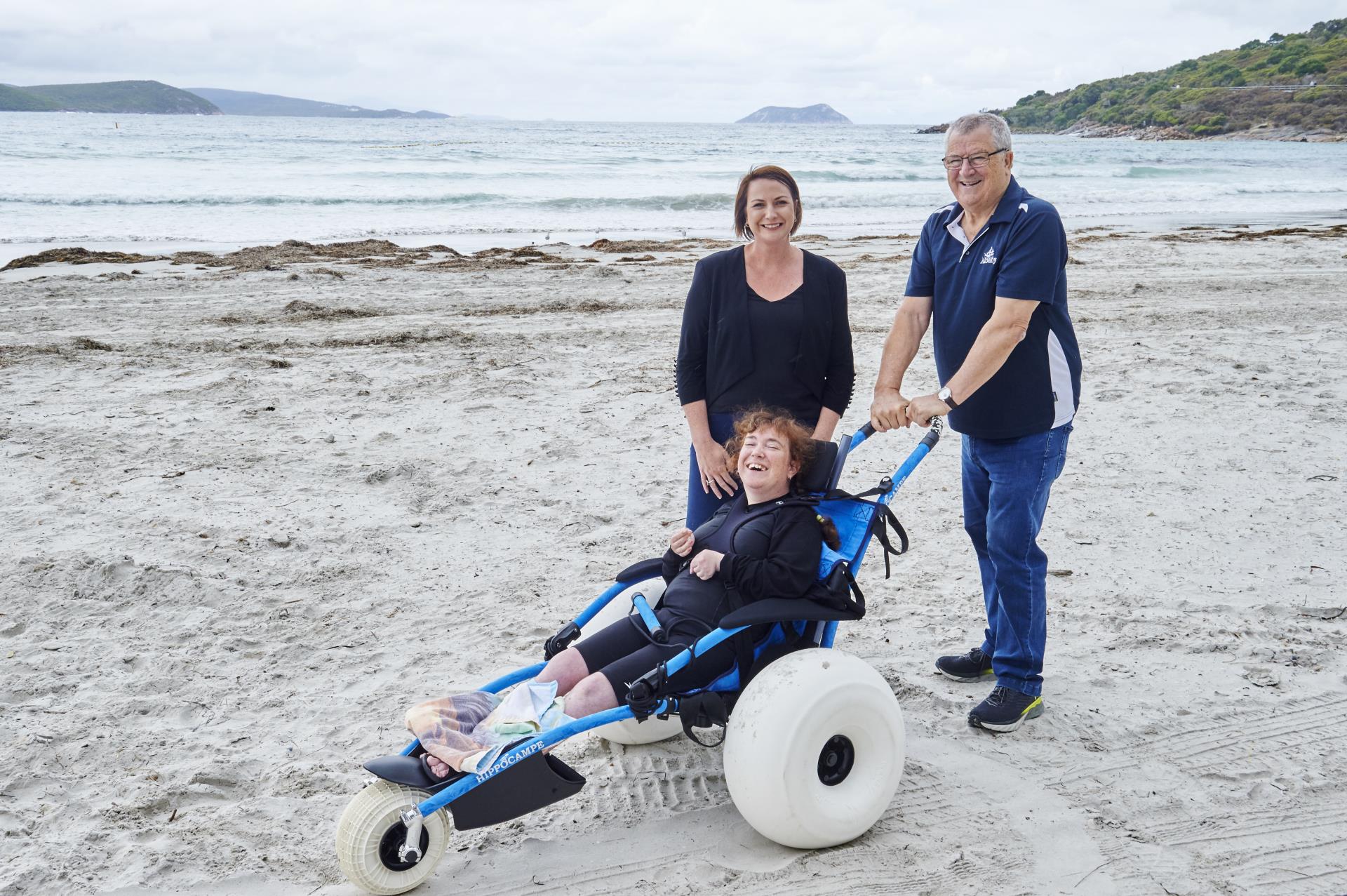
The City offers free use of beach wheelchairs and beach walkers at both Middleton Beach and Emu Point, so people who have mobility impairments can also enjoy Albany's popular tourist beaches.
Our wheelchairs and walkers can be accessed on a 24/7 basis.
In 2022, the City of Albany purchased a new beach wheelchair for Middleton Beach, supported by the Department of Communities. In 2025, the City purchase a brand new beach wheelchair to replace the aging one at Emu Point and two new beach walkers, one to go at Emu Point Beach and one at Middleton Beach
How to Book the Beach Wheelchairs / Walkers:
- Call 0417 964 102 to make a booking with City of Albany security to open the wheelchair storage. Please call at least 30 minutes prior to your preferred booking time, and remember to state which location.
- Meet the security guard at the storage venue at your scheduled time and provide your contact information to the security guard.
- Arrange a time to meet the security guard to return the wheelchair / walker after use.
Beach Wheelchairs
The all-terrain wheelchairs at Middleton and Emu Point Beaches offers interchangeable floating and neutral buoyancy wheels.
Life jackets and a transfer mat to assist with moving the user to and from the wheelchair are also available.
Beach Walkers
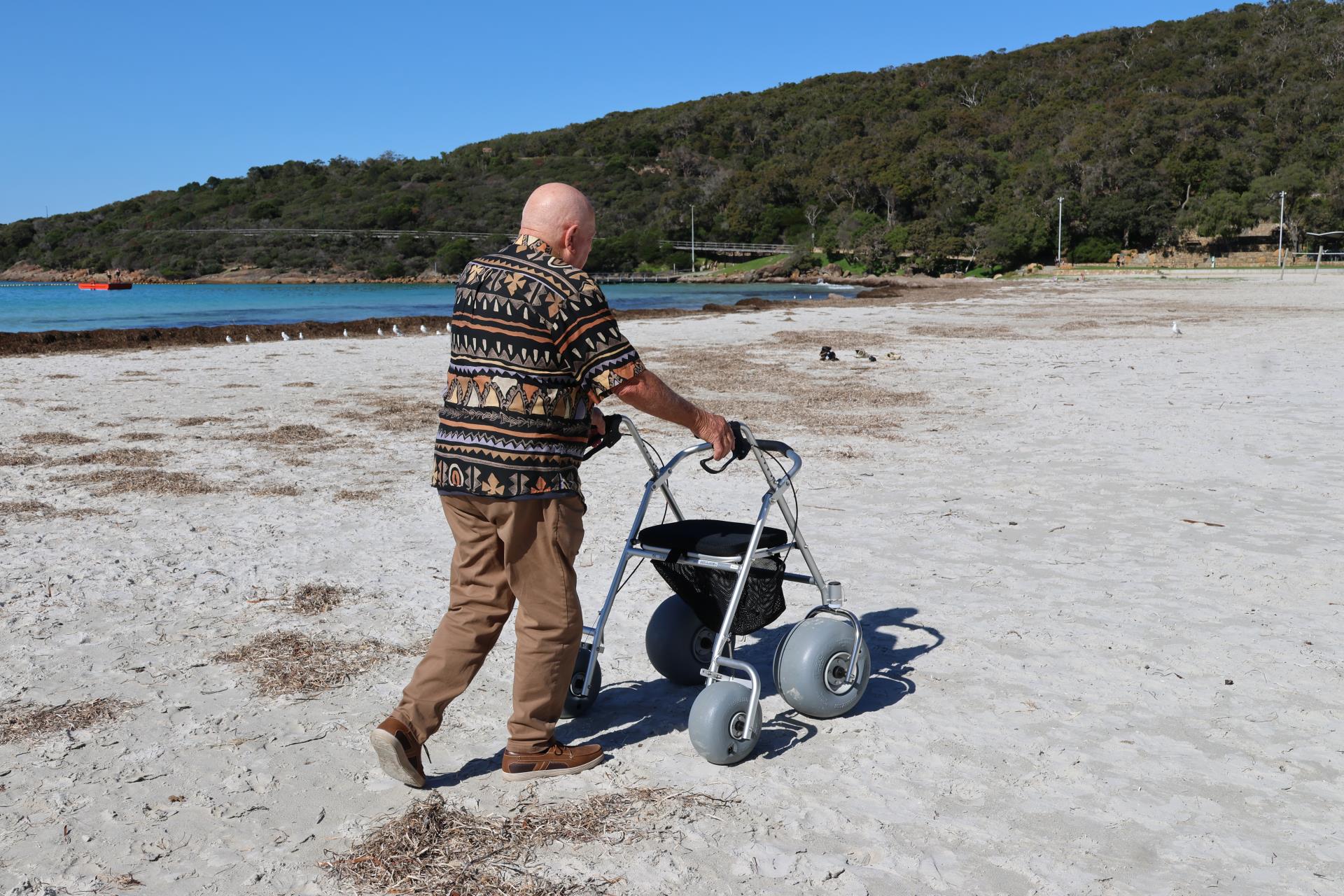
The beach walkers at Middleton and Emu Point are fitted with floating wheels, adjustable walking supports, a seat, and storage under the seat - PLEASE REMEMBER TO TAKE YOUR BELONGINGS WITH YOU AFTER USE
Before using either the wheelchairs or walkers, please read the Safety Guide & User Manual (linked below).
Beach Wheelchair and Walker Safety Guide & User Manual
Beach Matting
There is beach matting at Emu Point and Middleton Beach which enables wheelchair and mobility aid users access to firmer sand to enjoy beach outings.
Inclusive Recreation and Leisure
Inclusive Sporting Clubs
The City has developed a guide to assist sporting and recreation clubs to be more accessible and inclusive for people with disability. The guide was developed in partnership with the Princess Royal Sailing Club's Sailability Program. Download the guide below.
Guide to Inclusion for Sporting Clubs
Accessible Playgrounds
The City continually upgrades its playgrounds and equipment and is increasingly adding accessible 'all abilities' equipment to the suite of available play equipment. Currently, the following parks offer 'all abilities' equipment for people who cannot use regular play equipment:
- Emu Point
- Cull Park (limited wheelchair access)
- Mills Park (limited wheelchair access)
- Eyre Park
Accessible Fishing
Find accessible fishing locations along our beautiful coastline using this interactive map thanks to the work of Fishability. Click below to access the map.
Fishability's Accessible Fishing Spots
Changing Places
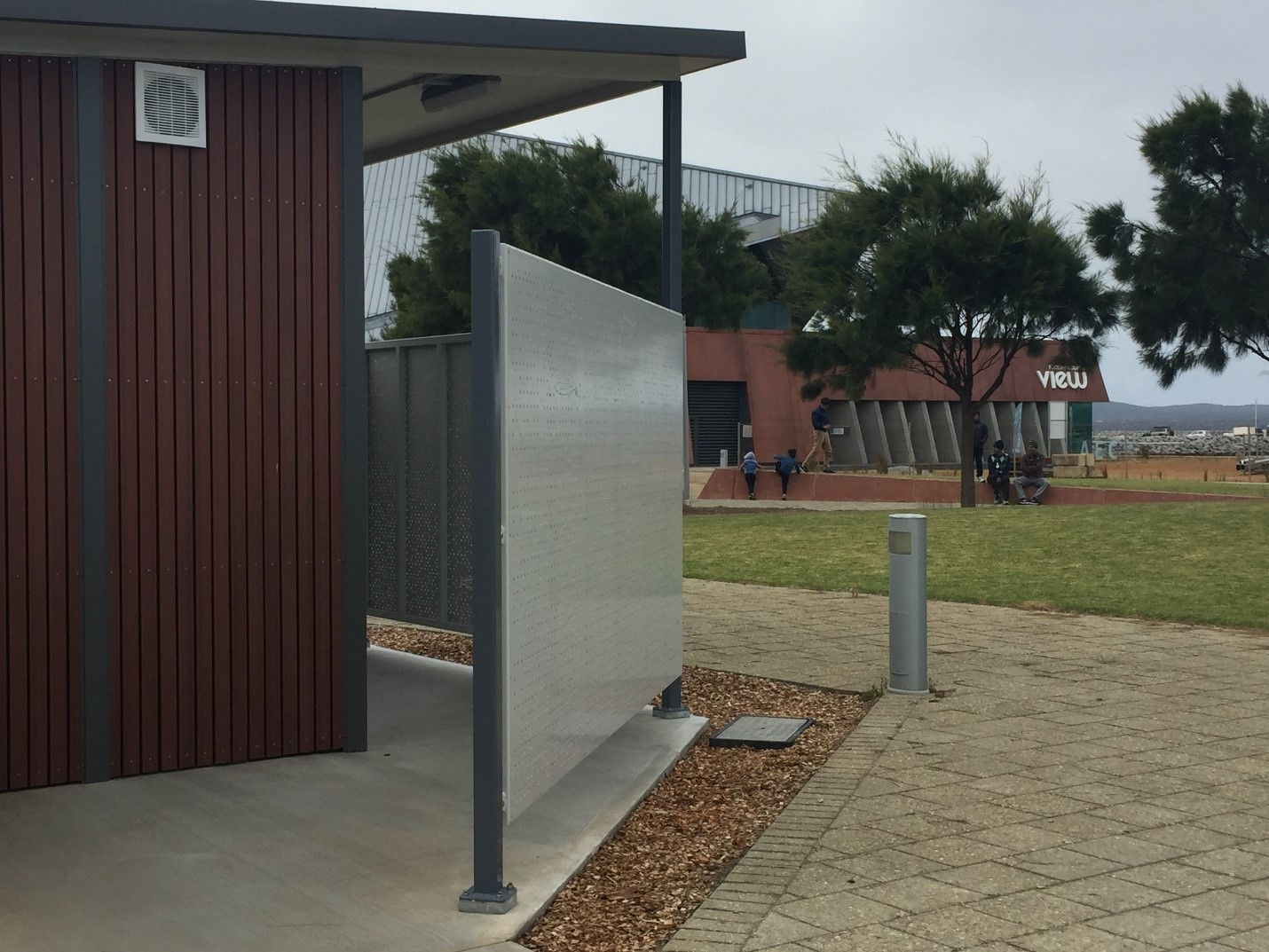
Albany's inaugural Changing Place is now open to eligible users. This secure and clean bathroom is specifically designed for people who need space and assistance to manage their bathroom needs while in the community, and for whom universal access toilets are not suitable.
The Changing Place is conveniently located adjacent to the Albany Entertainment Centre at 293 Princess Royal Drive and can be accessed either via the Stirling Terrace footbridge, or there is ACROD parking directly behind the Changing Place.
Access to the Changing Place in Albany, or anywhere in Australia, is via a Master Locksmiths Access Key (MLAK). To check eligibility for an MLAK, please contact the Master Locksmiths Association of Australia at www.masterlocksmiths.com.au/mlak or phoning 03 9994 1557. Temporary keys can be obtained from the Albany Visitor Centre on York Street, the Albany Library, or from the City's Administration Building on North Road for a 4-hour period upon payment of a deposit, fully refunded upon return of the key.
The Changing Place offers the following features:
- Fully electric, height-adjustable Adult Change Table. Before use, please download and read the manufacturer's instructions (see below). The Adult Change Table is rated to hold a maximum weight of 200kg.
- Fully electric Ceiling Hoist. The Hoist is also rated to hold a maximum weight of 200kg. Before use, please download and read the manufacturer's instructions (see below).
- Peninsula Toilet that can be mounted from the left or right-hand side.
- Shower, including a wall-mounted seat for convenience.
- Adult diaper disposal for convenience.
- Disposable Change Table covers that are placed conveniently next to the Change Table.
Users will need to supply their own slings for use in the hoist, which is designed for use with loop style slings. If you are unsure whether your sling can be used in this Changing Place, please contact the supplier or prescribing therapist. Alternatively, you can call the Independent Living Centre Advisory Service on 1300 885 886.
This Changing Place forms part of a state-wide Network. Other Changing Places across WA can be located on the National Public Toilet Map or the Changing Places Australia Toilet Map. You can use either of these maps to plan your journey.
For cleaning or maintenance issues, or in the event of an emergency, please contact the City's Call Centre on 1800 633 000. More information about this Changing Place can be obtained from the Community Development Team on (08) 6820 3023 or by emailing [email protected]
Changing Places Change Table Instructions
Changing Places Hoist Instructions
Inclusive Fuel Stations
The City of Albany Access & Inclusion Working Group, in conjunction with APM Communities, has developed a map for Inclusive Fuel Stations in Albany. During an Albany Access & Inclusion Committee Meeting an action item was raised to research accessible fuel stations. APM Communities consulted with Albany local Bob Rees to gain a better understanding of refueling challenges. Following the consultation a survey was designed for Fuel Stations in the Great Southern and results were collated. The findings and recommendations were presented to the Albany Access & Inclusion Committee. Please find below the map of Inclusive Fuel Stations in the City of Albany.
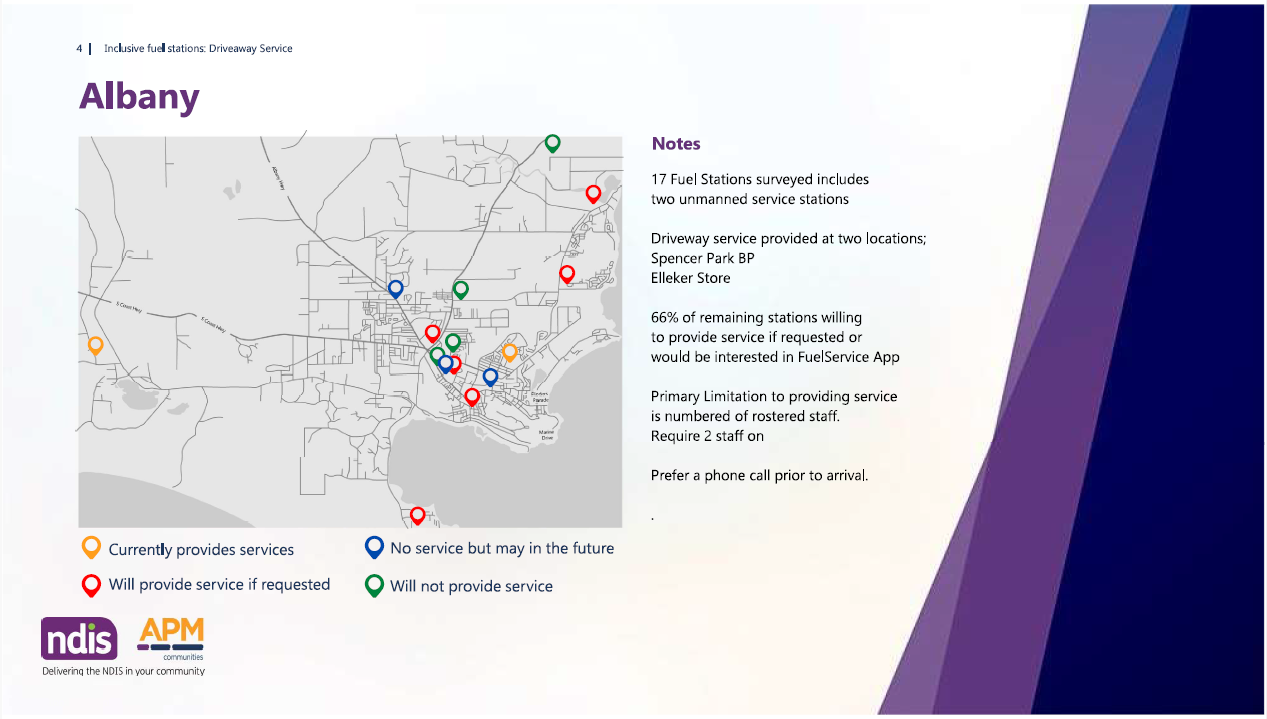
Inclusive Fuel Stations Albany Map
Support Resources
If you have experienced or witnessed a person with disability being hurt, treated badly or neglected, you can report it to the National Disability Abuse and Neglect Hotline (the Hotline).
The Hotline is free, independent and confidential and available to anyone, including people with disability, their family members, friends and service providers.
It will work with you to find ways of dealing with what you have reported through information, support and referrals to other organisations.
The Hotline will also encourage you to seek advocacy support if needed.
It’s open Monday to Friday, 9am to 7pm Australian Eastern Standard Time (AEST) and Australian Eastern Daylight Saving Time (AEDST), excluding Australian national public holidays.
Find out more:
The National Disability Advocacy Program (NDAP) is funded by the Department of Health, Disability and Aging to provide people with disability access to effective advocacy support. This support works to promote and protect the rights of people with disability by helping to remove barriers to their full and equal participation in the community.
NDAP is for people with disability who are facing complex challenges. The program provides support in situations where people with disability feel unable to act, speak or write about a difficult situation on their own, or do not have the support required to resolve an issue.
How a disability advocate can help
Read the disability advocacy for individuals fact sheet to learn more about how an advocate can assist people with disability.
An advocate can provide information, help an individual explore their options and work through issues, and make informed decisions. Through NDAP, an advocate can assist individuals to:
- understand and exercise their rights
- self-advocate, wherever possible
- identify and address situations of violence, abuse, neglect or exploitation
- make a complaint
- understand and/or access the NDIS, Centrelink and other government services
- find and use community services, including legal services
- request extra support (such as reasonable adjustments) at school or work.
- Services for specific needs or backgrounds
Some NDAP organisations provide support for specific needs and/or backgrounds, including people:
- with a specific type of disability (for example intellectual disability)
- seeking help for a specific issue (for example housing, education or employment)
- from a culturally and linguistically diverse background
- who are Aboriginal and/or Torres Strait Islander.
Find out more information on the National Disability Advocacy Program website here.
To report abuse or neglect of a person with disability anywhere in Australia, contact the National Disability Abuse and Neglect Hotline (the Hotline) on 1800 880 052. The Hotline is a free, independent and private service.
More information on how to report abuse, click here.
NDIS participants have the right to receive quality respectful NDIS supports and services that follow the Code of Conduct. You can report an issue with the quality and safety of the NDIS supports you or an NDIS participant receives.
Your report can help protect other participants and improve the quality of supports.
Report the issue to the NDIS Commission
The NDIS Commission can:
- help you understand your rights as a person with disability and an NDIS participant
- give you information to help you resolve the issue with your provider or another organisation
- when needed, use the information you give us to create a complaint.
People who can’t advocate for themselves – like a child or non-verbal person – are at greater risk of harm or injury. Report these issues to the NDIS Commission immediately.
The Disability Gateway connection hub has a list of useful contacts in case of emergency, safety, and help. These can be viewed by clicking here